> For the complete documentation index, see [llms.txt](https://hezhiqiang.gitbook.io/elkstack/llms.txt). Markdown versions of documentation pages are available by appending `.md` to page URLs; this page is available as [Markdown](https://hezhiqiang.gitbook.io/elkstack/logstash/examples/ossec.md).
# ossec日志
*本节作者:林鹏*
## 配置OSSEC SYSLOG 输出 (所有agent)
1. 编辑ossec.conf 文件(默认为/var/ossec/etc/ossec.conf)
2. 在ossec.conf中添加下列内容(10.0.0.1 为 接收syslog 的服务器)
```
10.0.0.1
9000
default
```
1. 开启OSSEC允许syslog输出功能
```
/var/ossec/bin/ossec-control enable client-syslog
```
1. 重启 OSSEC服务
```
/var/ossec/bin/ossec-control start
```
## 配置LOGSTASH
1. 在logstash 中 配置文件中增加(或新建)如下内容:(假设10.0.0.1 为ES服务器,假设文件名为logstash-ossec.conf )
```
input {
udp {
port => 9000
type => "syslog"
}
}
filter {
if [type] == "syslog" {
grok {
match => { "message" => "%{SYSLOGTIMESTAMP:syslog_timestamp} %{SYSLOGHOST:syslog_host} %{DATA:syslog_program}: Alert Level: %{BASE10NUM:Alert_Level}; Rule: %{BASE10NUM:Rule} - %{GREEDYDATA:Description}; Location: %{GREEDYDATA:Details}" }
add_field => [ "ossec_server", "%{host}" ]
}
mutate {
remove_field => [ "syslog_hostname", "syslog_message", "syslog_pid", "message", "@version", "type", "host" ]
}
}
}
output {
elasticsearch_http {
host => "10.0.0.1"
}
}
```
## 推荐 Kibana dashboard
社区已经有人根据 ossec 的常见需求,制作有 dashboard 可以直接从 Kibana3 页面加载使用。
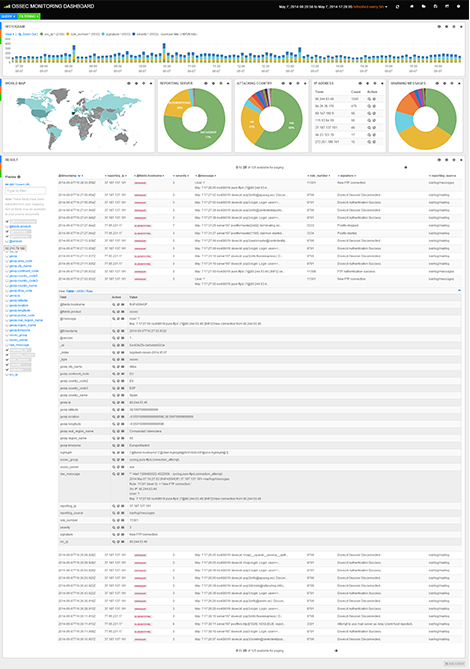
dashboard 的 JSON 文件见:
加载方式,请阅读本书稍后 Kibana 章节相关内容。