> For the complete documentation index, see [llms.txt](https://hezhiqiang.gitbook.io/about-the-author/llms.txt). Markdown versions of documentation pages are available by appending `.md` to page URLs; this page is available as [Markdown](https://hezhiqiang.gitbook.io/about-the-author/yun-wei-huan-jing-da-jian/centos-8-an-zhuang-mysql-8-jiao-cheng.md).
# CentOS 安装 Mysql 8.0
#### 博客作者:联系请[点击](https://hezhiqiang.gitbook.io/about-the-author/lian-xi-zuo-zhe),搬运不易,希望请作者喝咖啡,可以点击联系[博客作者](https://hezhiqiang.gitbook.io/about-the-author/lian-xi-zuo-zhe)
{% hint style="info" %}
摘要: CentOS 8 安装MySQL 8.0 并配置远程登录
{% endhint %}
### 安装MySQL8.0
使用最新的包管理器安装MySQL
```
dnf install @mysql
```
### 开启启动
安装完成后,运行以下命令来启动MySQL服务并使它在启动时自动启动:
```
systemctl enable --now mysqld
```
要检查MySQL服务器是否正在运行,请输入:
```
systemctl status mysqld
```
### 添加密码及安全设置
运行mysql\_secure\_installation脚本,该脚本执行一些与安全性相关的操作并设置MySQL根密码:
```
mysql_secure_installation
```
步骤如下:
1. 要求你配置VALIDATE PASSWORD component(验证密码组件): 输入y ,回车进入该配置
* 选择密码验证策略等级, 我这里选择0 (low),回车
* 输入新密码两次
* 确认是否继续使用提供的密码?输入y ,回车
* 移除匿名用户? 输入y ,回车
* 不允许root远程登陆? 我这里需要远程登陆,所以输入n ,回车\
[](https://img2018.cnblogs.com/blog/981325/201911/981325-20191126145030142-806823861.png)
2. 移除test数据库? 输入y ,回车
3. 重新载入权限表? 输入y ,回车\
[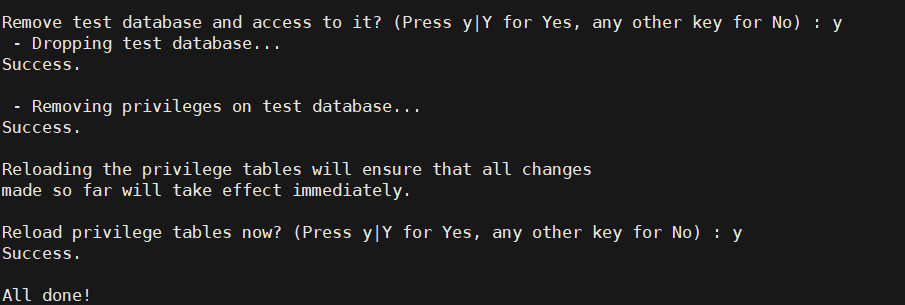](https://img2018.cnblogs.com/blog/981325/201911/981325-20191126145056520-234675009.png)
### 配置远程登陆
如果需要设置root账户远程登陆,上一步骤中,`不允许root远程登陆?`这一步需要设为n。\
接下来本机登录MySQL,将root用户的host字段设为'%',意为接受root所有IP地址的登录请求:\
本机登录MySQL:
```
mysql -uroot -p<上面步骤中设置的密码>
```
回车后即可登录,接下来终端变成了`mysql>`开头:
接着继续执行mysql语句,将将root用户的host字段设为'%':
```
use mysql;
update user set host='%' where user='root';
flush privileges;
```
#### 查询远程登录权限
```
select host,user from user;
```
**修改连接权限执行:**
```
update user set host='%' where user ='root';
```
**更改加密方式执行:**
```
update user set plugin='mysql_native_password' where user ='root';
```
**授权远程连接:**
```
grant all on *.* to 'root'@'%';
```
设置完成后输入exit退出mysql,回到终端shell界面,接着开启系统防火墙的3306端口:
```
sudo firewall-cmd --add-port=3306/tcp --permanent
sudo firewall-cmd --reload
```
### 关闭MySQL主机查询dns
MySQL会反向解析远程连接地址的dns记录,如果MySQL主机无法连接外网,则dns可能无法解析成功,导致第一次连接MySQL速度很慢,所以在配置中可以关闭该功能。\
[参考文档](https://www.cnblogs.com/liruning/p/7111015.html)\
打开`/etc/my.cnf`文件,添加以下配置:
```
[mysqld]
skip-name-resolve
```
### 重启服务[#](https://www.cnblogs.com/kasnti/p/11929030.html#3532493344)
```
systemctl restart mysqld
```
本机测试安装后,MySQL8.0默认已经是utf8mb4字符集,所以字符集不再修改